
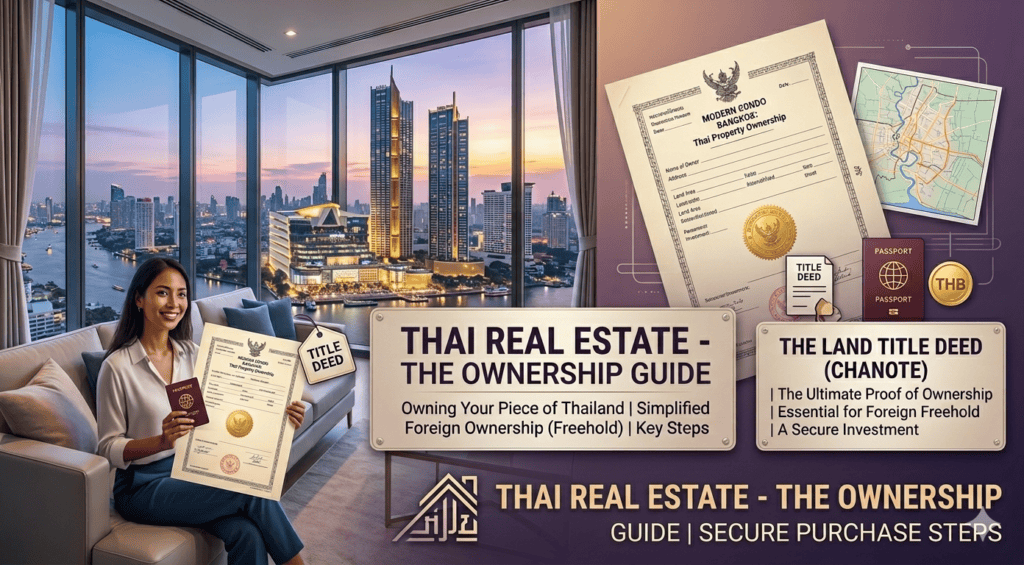
For many expats living in Thailand or considering a long-term move, buying property is a natural step. But Thailand’s property laws are complex — and they’re built with a clear principle in mind: foreigners cannot own land. However, there are several legal ways to own or control property as a foreigner. Here’s what you need to know.
The Golden Rule: Foreigners Cannot Own Land
This is the fundamental rule in Thailand. The Land Code explicitly prohibits foreigners from owning land — there are no exceptions, and no loopholes that are legally defensible. If you want to own property in Thailand, you have several legal options, but owning raw land outright is not one of them.
What Foreigners CAN Own in Thailand
1. Condominiums (Apartments)
This is the most straightforward option for foreign property ownership. You can own a condominium unit outright — the building and the land belong to the condominium juristic person (the collective management entity), not to you individually.
The rules:
- You can own a condo unit in your own name
- Foreign ownership is capped at 49% of the total units in a building
- Before buying, verify the building’s current foreign ownership percentage — if it’s at or near 49%, you won’t be able to purchase
- You own the interior space; the land and common areas are managed by the condominium
- Condos in popular expat areas (Bangkok, Chiang Mai, Phuket) are readily available and mortgages are possible
This is the best option for most foreign buyers.
2. Leasehold Property
You can lease land or buildings for up to 30 years — and in practice, you can often renew the lease for additional 30-year terms after the initial lease expires. A 30-year leasehold is effectively a long-term ownership right, though technically the land remains the property’s owner.
Important caveat: The Supreme Court has ruled that pre-agreed lease renewals beyond the initial 30 years are unenforceable. In practice, most property owners honor renewal arrangements, but there’s no legal guarantee. This is why it’s critical to get independent legal advice before signing any long-term lease.
Leasehold is popular for: House rentals, commercial properties, and expats who want more space than a condo offers.
3. Usufruct Rights
A usufruct is a registered right that gives you lifetime use and benefit from a property — you can live in it, rent it out, and pass the right to your heirs. It’s stronger than a lease because it’s registered at the land office and survives changes in land ownership.
Why choose usufruct?
- Stronger legal protection than a simple lease
- Can be inherited (unlike a lease, which typically expires)
- Registered at the land office, creating a public record
- You have lifetime rights to the property
The catch: Finding properties with usufruct arrangements is less common, and you depend on the cooperation of the land owner for maintenance and structural issues.
4. Superficies (Building Ownership on Someone Else’s Land)
You can own a building on land owned by someone else for up to 30 years (renewable). This gives you ownership of the structure while someone else owns the land. It’s used less commonly than condos or leaseholds, but it’s a legal option.
5. Sap-ing-sith (Registered Benefit)
This is a newer legal option that allows you to register a long-term right to use and benefit from land. It’s stronger than a simple lease because it’s registered with the land office and provides legal protection against changes in land ownership.
Available since 2019, sap-ing-sith is becoming more common in new development projects.
What Foreigners CANNOT Do
- Own land: This is absolute. No workarounds or nominee arrangements are legally defensible.
- Use nominee companies: Registering property in a Thai company where you’re the hidden owner is illegal. The Thai government has tightened enforcement in recent years.
- Own more than 49% of a condo building: This cap is strictly enforced.
- Rely on verbal lease renewals: Any long-term arrangement must be in writing and, ideally, registered.
The Process: Buying Condo Property as a Foreigner
If you’re buying a condo, here’s what to expect:
- Find a property — Use a local agent or expat-friendly websites. Verify the building’s foreign ownership percentage.
- Negotiate and agree on price — Offers and counteroffers are normal.
- Hire an independent lawyer — Do not use the seller’s lawyer or a lawyer recommended by the agent. Get your own independent legal counsel. This is crucial.
- Conduct due diligence — Your lawyer will check title deeds, verify there are no encumbrances, and ensure the building has a valid condominium license.
- Sign the contract and transfer deeds — This happens at the Land Office with both parties present.
- Pay taxes and transfer fees — Expect to pay 2% in transfer fees and potentially capital gains tax (depends on your situation).
- Register the property in your name — The Land Office issues a new title deed in your name.
Financing: Can Foreigners Get a Mortgage?
Yes, but it’s more restrictive than for Thai nationals. Thai banks typically require:
- A Thai bank account (usually a few months old)
- Proof of income (salary, business income, or rental income from Thai property)
- A work permit or long-term visa
- A deposit of 25–40% of the purchase price
- Interest rates are typically 2.5–4% for a 15-year term
Foreign banks or international mortgage brokers also operate in Thailand, but terms vary widely.
Tax Implications
Capital gains tax: If you sell within 5 years, you may owe 5% capital gains tax. After 5 years, no tax is owed. (Some exemptions apply if you’re a Thai resident.)
Rental income tax: If you rent out the property, you’ll pay income tax on the rental income (rates vary by income level).
Annual property tax: A small annual tax (0.02% of assessed value) is levied on property ownership.
Key Takeaways
- Condos are the simplest option — you own the unit outright, subject to the 49% foreign ownership cap.
- Get independent legal advice — this is non-negotiable. Do not use the seller’s lawyer.
- Understand the 30-year limitation — leases beyond 30 years are not guaranteed in law.
- Check the building’s foreign ownership percentage — before you commit to buying.
- Never use a nominee arrangement — it’s illegal and leaves you with no legal protection.
- Be aware of taxes — capital gains tax, income tax on rentals, and annual property tax all apply.
Bottom line: Buying property in Thailand as a foreigner is absolutely possible — just make sure you understand the rules and get proper legal advice before you sign anything.
For everything else you need before moving to Thailand long-term — visas, work permits, healthcare, and logistics — see our Thailand Travel Logistics Guide.