
Disclosure: Some of the links in this article are affiliate links. If you book through them, we may earn a small commission — at no extra cost to you. We only recommend places we genuinely love.
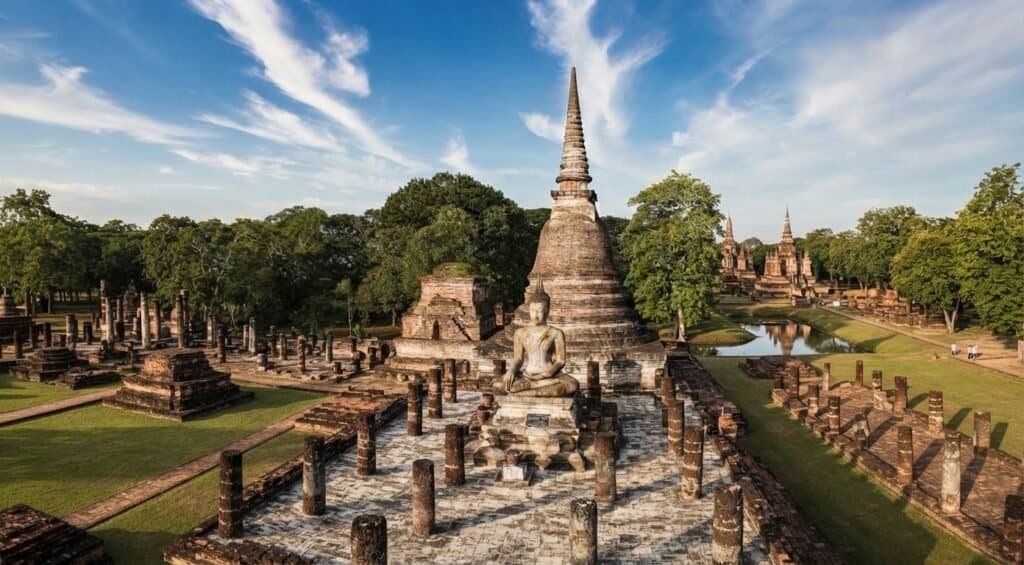
Based on my time exploring Thailand’s ancient capitals, Sukhothai is the one that actually feels like a lost city — none of the tour-bus crush you get in Ayutthaya, just crumbling brick chedis rising out of lotus ponds with barely another visitor in sight. If Ayutthaya is Thailand’s history with a crowd, Sukhothai is Thailand’s history with room to breathe.
Why Sukhothai Matters
Sukhothai was Thailand’s first proper capital, founded around 1238, and it’s where much of Thai artistic and cultural identity actually took shape — the modern Thai alphabet, the elongated Buddha faces, the distinctive lotus-bud chedi style you’ll recognize in temples across the country. It’s a UNESCO World Heritage Site, and unlike Ayutthaya, it rarely feels crowded even in the ruins closest to the entrance.
Local tip: Most travelers rush Sukhothai as a quick stop between Bangkok and Chiang Mai. Don’t. Give it a proper half-day minimum — the Central Zone alone rewards slow wandering, and the light in early morning or late afternoon makes the ruins genuinely beautiful in photos, not just historically interesting.
Entrance Fees & Opening Hours (2026)
📋 Know Before You Go:
The park is split into ticketed zones — Central, North, and West — each charging separately (roughly 100 THB per zone for foreigners; there’s no combined day pass anymore). South and East zones are free.
Bringing a bicycle in adds a small surcharge (around 10 THB per zone).
Hours: roughly 6:30 AM – 7:30 PM daily. On Saturday evenings, the Central Zone stays open later (around 9 PM) for a free sound-and-light show at Wat Sa Si.
Cash only at the ticket booths — bring baht, as there’s no card payment at the gates.
Getting Around: Rent a Bike
The park is flat, spread out, and genuinely too large to comfortably cover on foot. Bicycle rental shops line the road opposite the Central Zone entrance for around 30-50 THB a day — it’s the classic and honestly the best way to move between temples, gliding past lotus ponds with almost no traffic to worry about.
What to See
Wat Mahathat (Central Zone): The heart of the old city and the park’s most important temple — rows of seated Buddha images, chedis, and the site most visitors spend the bulk of their time exploring.
Wat Si Chum (North Zone): My personal favorite, and arguably the single most striking sight in the whole park. A massive mondop houses a 15-meter seated Buddha, first glimpsed through a narrow slot in the outer wall before you step inside and see its full scale. It’s a genuine “stop in your tracks” moment.
Wat Sa Si: A graceful temple on an island in a lotus-filled pond, with a striking walking Buddha statue — this is where the Saturday night light show takes place.
Wat Si Sawai: Three Khmer-style prangs, a reminder that Sukhothai’s architecture blended influences well before it became a fully independent Thai kingdom.
🏛️ Skip the Zone-Fee Math, Go With a Guide:
A guided tour handles the zone tickets and bike logistics for you, and gives real context on what you’re actually looking at — the difference between a nice ruin and a genuinely fascinating one is usually the story behind it.
Sukhothai & Loy Krathong: A Special Connection
If you’re planning around Loy Krathong (November 24, 2026), Sukhothai is genuinely one of the best places in Thailand to experience it — this is where the festival is believed to have originated, and the city runs an extended festival program (this year from November 15 to 24) with krathongs floated among the ancient ruins themselves, lit by candlelight. It’s a completely different atmosphere from the crowds along Bangkok’s river. See our full Loy Krathong Festival Guide for more on the festival itself.
Getting There
Sukhothai sits between Bangkok and Chiang Mai, making it a natural stop on a northern loop. Direct buses run from Bangkok’s Mo Chit terminal (roughly 7-10 hours depending on service level), and there are also flights connecting to Bangkok. The Historical Park itself is about 12 km from New Sukhothai town, where most accommodation is based — a short songthaew or tuk-tuk ride from there.
🚌 Book Your Route in Advance:
Especially around Loy Krathong, seats on popular routes fill up fast — worth locking in your transport ahead of time.
Before You Go
The park has almost no shade over open ground, so bring water and go early or late to avoid the worst midday heat. Cover shoulders and knees if you plan to enter any active shrine areas. Signal is generally fine in New Sukhothai town but can drop out at the ruins themselves — worth having your eSIM set up before you head out for the day.
📱 Stay Connected Between Temples:
Get your eSIM sorted before you leave Bangkok or Chiang Mai so you’re covered for the whole day at the park.
For visas, transport passes, and more logistics tips, check our full Thailand Travel Logistics Guide.
Traveling by rail between destinations? See our Thailand Train Travel Guide for routes and booking tips.
Ready to Explore Thailand’s First Capital?