
Disclosure: Some of the links in this article are affiliate links. If you book through them, we may earn a small commission — at no extra cost to you. We only recommend services we genuinely trust.
When I first moved to Chiang Mai, I made every rookie mistake in the book — exchanged money at the worst possible booth, got hassled by a “closed temple” scammer on my second day, and paid way too much for a tuk-tuk because I didn’t know how to ask for the meter. Two decades of living and running businesses in Thailand later, here’s everything I wish someone had told me before I landed.
Money & Payments in Thailand
Thailand remains a heavily cash-based society. Credit cards work fine in hotels, upscale restaurants, and major malls, but cash is still king at night markets, street food stalls, local taxis, and anywhere on the smaller islands. The local currency is the Thai Baht (THB).
Withdrawing Cash from ATMs
ATMs are everywhere, usually right outside or inside 7-Eleven stores. Every withdrawal with a foreign card incurs a flat 220 THB fee on top of whatever your home bank charges.
Local tip: To minimize the damage, withdraw the maximum the machine allows per transaction (usually 20,000–30,000 THB) rather than making several smaller withdrawals.
Where to Exchange Currency
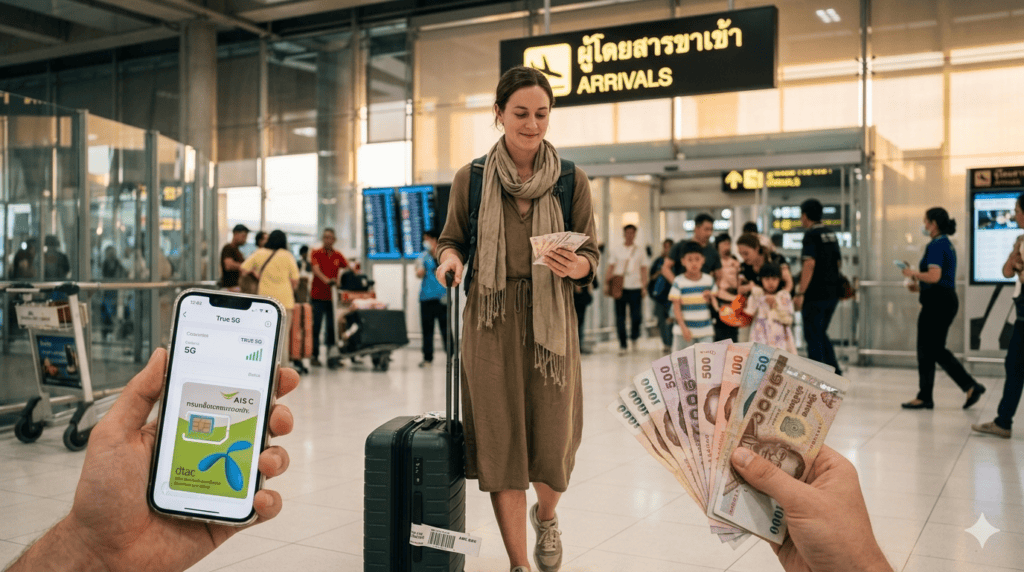
If you’re bringing cash (USD, EUR, or GBP), don’t exchange it all at the first booth you see after stepping off the plane — the rates on the arrivals floor at Bangkok’s Suvarnabhumi Airport are notoriously poor.
At the airport: Head down to the lowest level (Floor B, the Airport Rail Link station). Near the train platform, you’ll find private exchange booths like SuperRich offering much better rates.
During your trip: Look for orange or green SuperRich booths around the city, or compare rates between bank booths. Make sure your bills are clean, crisp, and untorn — Thai exchanges can be strict about bill condition.
Stay Connected: SIM Card vs. eSIM
Having data on your phone the moment you land isn’t optional in Thailand — you’ll need it for navigation, translation, and booking rides. You have two main options.
The Modern Solution: eSIM (Recommended)
A reliable travel eSIM means you step off the plane already online — no airport queues, no SIM-swapping at the counter. If your phone supports eSIM, this is by far the easiest option: buy a Thailand data plan before you even leave home and activate it the moment you land.
📱 Skip the Airport SIM Counter:
Set up your eSIM before you fly so you’re connected the second you land — no queues, no passport paperwork at a kiosk.
Physical Tourist SIM at the Airport or 7-Eleven
If you prefer a physical SIM, you can buy a “Tourist SIM” from major local providers (AIS, TrueMove, or DTAC) right after passport control at the airport, or at any 7-Eleven. Staff will swap the card and activate the plan for you. Note: you must present your passport to register a SIM card.
Transportation & Ride-Hailing Apps
Getting around Thailand ranges from colorful tuk-tuks to high-speed trains. A few golden rules will save you a lot of haggling.
Must-Have Ride-Hailing Apps (Grab & Bolt)
Grab is the most popular and reliable app in Southeast Asia — the local equivalent of Uber. Book taxis, private cars, or motorbikes, with a fixed price shown upfront, no language barrier and no overcharging.
Bolt is a competing app that often runs cheaper than Grab, though driver availability can be lower during peak rush hours.
Local tip: Download and register for both apps while you’re still at home. Verification requires an SMS code, which is far easier to receive on your home number before you switch your SIM.
Regular Taxis and Tuk-Tuks
If you hail a regular metered taxi on the street (the bright pink or yellow-green cabs in Bangkok), the driver is legally required to use the meter. Don’t ask “how much to go to…?” — just step in and say “taxi meter, please.” If the driver refuses and insists on a fixed price, get out and hail the next one.
Tuk-tuks don’t have meters, and prices must be negotiated before you get in. These days they function mostly as a fun tourist experience rather than a cheap way to commute — price them accordingly.
Intercity Trains and Buses: Book in Advance
If you’re traveling between regions — the popular overnight sleeper from Bangkok to Chiang Mai, or a bus to Pattaya or Kanchanaburi — don’t wait until the last minute. Tickets for popular routes, especially 1st and 2nd class sleeper berths, sell out weeks ahead. See our full Thailand Train Travel Guide for routes and classes.
🚌 Lock In Your Seat Early:
Booking through a third-party platform is far less of a headache than fighting the official portal with a foreign card.
Visas & Crucial Entry Rules
Visa-Exempt Entry (The 30-Day Rule)
For citizens of many countries — including Israel, the US, the UK, and EU nations — Thailand’s Visa Exemption scheme lets you enter for tourism without applying for a visa in advance. As of September 15, 2026, the permitted stay is 30 days, down from the 60-day allowance that had been in place since mid-2024. If you entered before September 15, 2026, you keep the full 60-day stamp you were originally given — the shorter limit only applies to entries from that date onward.
Extensions: If you decide to stay longer, you can usually extend this entry for an additional 30 days at a local immigration office inside Thailand for a fee of 1,900 THB.
Requirements: Make sure your passport is valid for at least 6 months from your date of entry, and always have proof of a return or onward flight handy, as airlines sometimes check this before boarding.
For the full breakdown of visa options, extensions, and the mandatory digital arrival card, see our complete Thailand Visa Guide 2026.
Staying Safe: Scams & Essential Etiquette
The “Closed Temple” Scam: If a friendly tuk-tuk driver or stranger outside a major tourist spot (like the Grand Palace in Bangkok) tells you the temple is “closed for a holiday” or “monks are praying,” ignore them. They’ll try to redirect you to a jewelry store or a sketchy travel agency. Walk right up to the official entrance yourself to verify.
Respect the Monarchy and Religion: Never make jokes or disrespectful comments about the Thai Royal Family — this is a serious legal offense known as Lese Majeste. When visiting temples, make sure your shoulders and knees are covered, and always remove your shoes before stepping inside a holy area.
🩺 One More Thing Before You Land:
Private hospital care in Thailand is excellent but not cheap — travel insurance is the difference between a bad afternoon and a bad trip.
Ready to Land Like a Pro?