
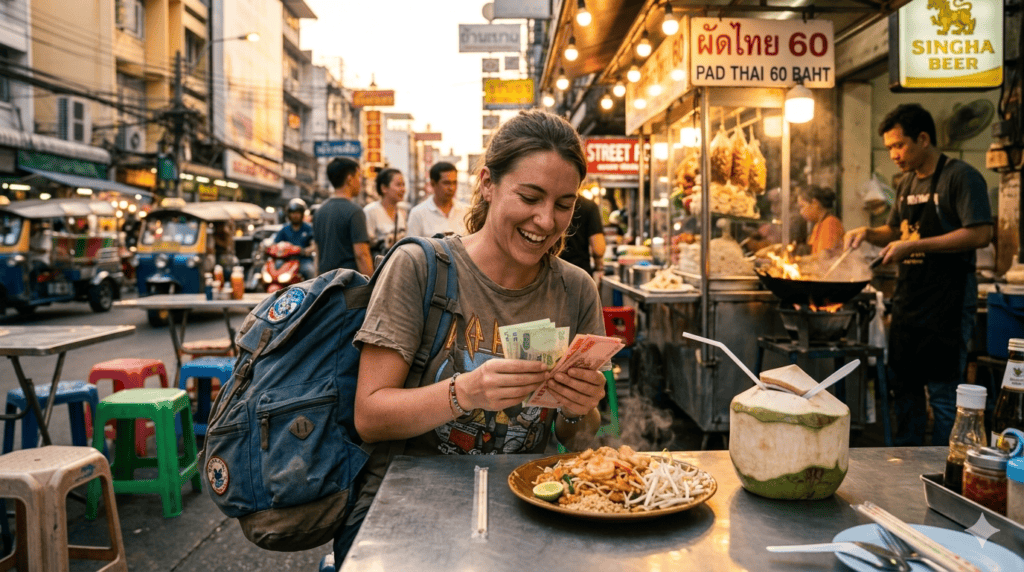
Thailand is one of the best value destinations in the world — but “how much does a Thailand trip cost?” depends entirely on how you travel. A backpacker can get by on $30 a day. A mid-range couple can live very well on $150. A luxury traveller can spend $500 and still feel like they got a bargain compared to Europe or the US.
This guide breaks down every real cost you’ll face in 2026 — accommodation, food, transport, activities, SIM cards, visas and travel insurance — so you can plan a budget that actually works.
Daily Budget Breakdown
Budget Traveller ($30–50/day)
Staying in hostels or basic guesthouses, eating street food and local restaurants, and getting around by songthaew and local buses, Thailand is remarkably affordable. A $30–50 daily budget is very realistic if you’re not splurging on tours every day.
- Accommodation: $8–15 (hostel dorm or simple guesthouse)
- Food: $8–12 (street food and local restaurants)
- Transport: $3–5 (songthaew, local buses, occasional Grab)
- Activities: $10–20 (one paid activity per day)
Mid-Range Traveller ($80–150/day)
A private room in a decent hotel, a mix of local and tourist restaurants, and the freedom to book a day trip or two without overthinking it. This is the sweet spot for most travellers — comfortable but not extravagant.
- Accommodation: $30–60 (3-star hotel or boutique guesthouse)
- Food: $20–30 (mix of local and tourist restaurants)
- Transport: $10–20 (Grab, day trips, occasional domestic bus)
- Activities: $20–40 (tours and experiences)
Luxury Traveller ($200–500+/day)
Thailand’s luxury scene is world-class and genuinely good value compared to Western prices. A $300 per night resort in Koh Samui would cost triple that in the Maldives. If you’re travelling in style, Thailand delivers.
- Accommodation: $100–300 (4–5 star resort)
- Food: $50–100 (fine dining and rooftop bars)
- Transport: $30–50 (private transfers and taxis)
- Activities: $50–100 (private tours and experiences)
Accommodation Costs in Thailand
Hostels ($8–20/night)
Perfect for solo travellers and backpackers. Bangkok, Chiang Mai and the islands all have excellent hostels with social atmospheres, pools and organised events. A dorm bed in a well-rated Bangkok hostel runs $8–12; a private room in a hostel is $15–25.
Budget Hotels ($20–50/night)
Great value for couples and small families who want a private room without paying boutique prices. You’ll find clean, air-conditioned rooms with en-suite bathrooms across the country at this price point.
Mid-Range Hotels ($50–150/night)
Comfortable rooms, pools, breakfast included in many cases. This is where Thailand’s value really shines — you get genuine 4-star experiences for 3-star prices.
Luxury Resorts ($150–500+/night)
World-class resorts with infinity pools, private beach access and spa facilities. The Samui, Phuket and Koh Lanta luxury scenes are genuinely competitive with the best in Southeast Asia.
Agoda consistently offers the best prices on hotels across Thailand — and their last-minute deals are hard to beat.
Search Hotels on Agoda →
Food Costs in Thailand
Food is where Thailand really surprises people. Street food is extraordinary — and it costs almost nothing.
Street Food Prices (2026)
- Pad Thai from a street stall: $1–2
- Green curry with rice: $1.50–3
- Mango sticky rice: $1–2
- Fresh fruit shake: $1–2
- Singha beer at a 7-Eleven: $1.50–2
- Som tam (papaya salad): $1–1.50
- Khao man gai (chicken rice): $1–2
Sit-down restaurant meals run $5–15 per person. Western food (burgers, pizza, pasta) costs $8–20 per person. Rooftop bars and fine dining start around $30–60 per person.
The honest truth: if you eat where locals eat, you can spend $10–15 a day on food and eat very well. If you eat at tourist restaurants every meal, budget $30–50.
Transport Costs in Thailand
Before you budget for transport, make sure you’ve covered the basics — visas, SIM cards, airport transfers and getting between cities. Our Thailand Travel Logistics Guide covers all of it in one place.
Getting Between Cities
- Domestic flight (e.g. Bangkok–Chiang Mai): $30–80 one way
- Overnight train Bangkok–Chiang Mai: $15–40 (sleeper)
- VIP bus Bangkok–Chiang Mai: $12–20
- Ferry between islands (e.g. Koh Samui–Koh Phangan): $10–20
- Minivan between northern towns: $5–15
Getting Around Cities
- Grab taxi (Bangkok): $3–10 per trip
- BTS Skytrain (Bangkok): $0.50–2 per journey
- Songthaew (shared truck taxi): $0.50–1.50
- Tuk-tuk: $2–8 (always negotiate first)
- Scooter rental: $5–10 per day
12Go is the easiest way to compare and book transport across Thailand — trains, buses, ferries and flights in one place.
Compare Transport on 12Go →
Activity Costs in Thailand
- Phi Phi Islands day trip from Phuket: $35–60
- Elephant sanctuary visit (Chiang Mai): $60–100
- Thai cooking class: $30–50
- Muay Thai fight ticket: $20–40
- Temple entrance fees: Free–$5
- Scuba diving day trip (Koh Tao): $50–90
- Full-day city tour with guide: $30–60
- Night markets: Free to enter (budget $10–20 for food and shopping)
GetYourGuide has a huge range of verified tours across Thailand — day trips, cooking classes, island tours and more.
Browse Tours on GetYourGuide →
SIM Card & Data Costs
Staying connected in Thailand is cheap and easy. A local SIM card at the airport costs $5–15 for 30 days of unlimited data. The main providers are AIS, DTAC and True Move.
Alternatively, an eSIM means you can be connected the moment you land — no queuing at the airport counter, no physical card to lose. We use and recommend Yesim for Thailand — you set it up before you leave home and activate it on arrival.
Travel Insurance Costs
This is not optional. Medical care in Thailand can be expensive for serious issues, and evacuation costs from remote islands can run into thousands of dollars without insurance.
We recommend SafetyWing — it’s designed for travellers and runs around $45–60/month for most ages. It covers medical emergencies, evacuation and trip interruption.
Visa Costs for Thailand
Most nationalities get a free 60-day visa exemption on arrival (extended in 2024). If you plan to stay longer, a tourist visa costs around $35–40 and gives you 60 days with a 30-day extension option.
Always check the current rules at the Thai embassy website for your nationality before travelling.
How Much Does a 2-Week Thailand Trip Cost?
These estimates include accommodation, food, transport within Thailand and activities — but not international flights or travel insurance.
| Travel Style | Daily Budget | 2 Weeks Total |
|---|---|---|
| Budget Backpacker | $30–50/day | $420–700 |
| Mid-Range | $80–150/day | $1,120–2,100 |
| Luxury | $200–500+/day | $2,800–7,000+ |
Money-Saving Tips for Thailand
- Eat where locals eat. Street stalls and simple shophouse restaurants serve food that’s better and a fraction of the price of tourist restaurants.
- Take overnight trains and buses. You save a night’s accommodation and arrive rested. The overnight train from Bangkok to Chiang Mai is genuinely comfortable and one of the great travel experiences in Southeast Asia.
- Travel during shoulder season. May–June and September–October offer lower prices on accommodation and flights with less crowds. Weather is wetter but still very manageable.
- Use ATMs wisely. Thai ATMs charge a flat fee of around 220 baht ($6) per withdrawal regardless of amount. Withdraw larger amounts less often. Some banks (like Wise or Revolut) reimburse ATM fees.
- Book accommodation in advance for peak season. December–February is high season across Thailand. Popular spots fill up fast and prices spike. Book 2–4 weeks ahead for best rates.
- Use Grab instead of tuk-tuks. Grab shows you the price before you confirm — no negotiation, no surprises. Tuk-tuks are fun for a short ride but consistently more expensive.
- Get an eSIM before you leave. Airport SIM counters charge a premium. Set up an eSIM at home and save $5–10.
Final Money Tips
- Always carry Thai Baht cash — street food, markets and smaller guesthouses are cash-only
- ATM fees are 220 baht (~$6) per withdrawal — withdraw larger amounts less often
- Credit cards are accepted in hotels, malls and most tourist restaurants
- Haggling is fine at markets but approach it with good humour, not aggression
- Tipping is not obligatory but appreciated — 20–50 baht at restaurants, 100 baht for good guided tours
Ready to Plan Your Thailand Trip?
Find the best hotels, book transport between cities, and discover the best tours — all in one place.
Find Hotels on Agoda → Book Transport on 12Go → Browse Tours on GYG →
Pingback: Travel Insurance for Thailand: Why SafetyWing is a Must