
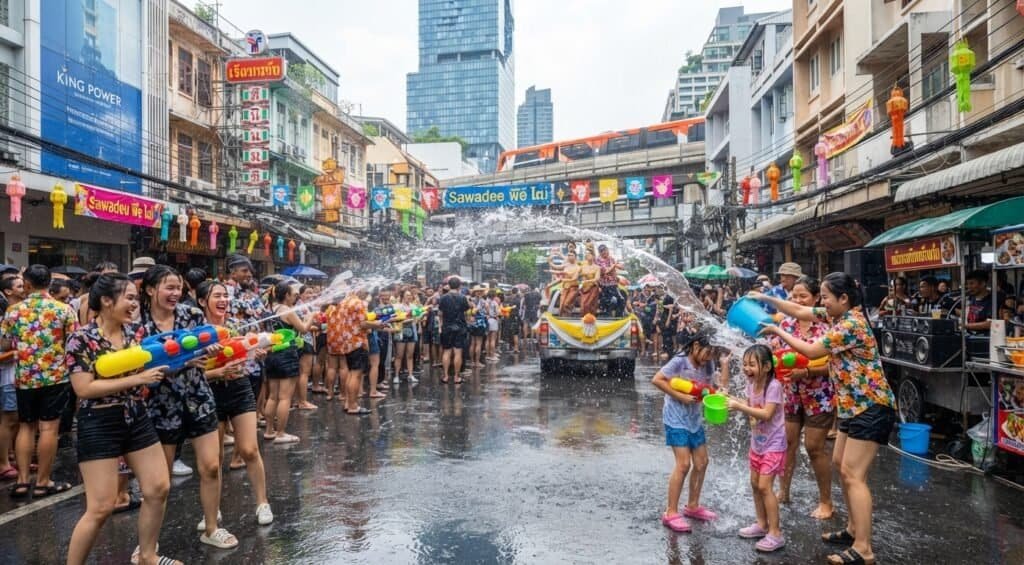
My first Songkran, I stepped outside for five minutes to buy water and came back soaked to the bone, laughing, with a stranger’s handful of talcum powder still stuck to my face. That’s the festival in one sentence: nobody stays dry, and almost nobody minds.
What Songkran Actually Is
Songkran is the traditional Thai New Year, and the water throwing started as a gentle, respectful act — pouring scented water over the hands of elders and Buddha images as a blessing. What it’s become, especially in cities, is a nationwide, days-long water fight with buckets, hoses, and water guns, in the streets, with strangers, with no warning and no mercy.
Both things are still true at once. If you walk through a neighborhood early in the morning, you’ll see the quiet, respectful version — temple visits, pouring water on Buddha statues, visiting elders. By midday on the main streets, it’s a different festival entirely.
When It Happens
Officially April 13–15, but don’t plan around just those three days. Chiang Mai in particular extends the water fighting for the better part of a week, and the official dates sometimes shift slightly year to year, so always confirm the current year’s dates before booking flights.
Where to Experience It
Chiang Mai
Widely considered the best city for Songkran — the moat around the Old City becomes the main battleground, with people lining the walls for days, refilling buckets straight from the water. It’s intense, loud, and genuinely the most fun version of the festival, but also the most relentless; there’s no “opting out” if you’re staying anywhere near the Old City.
Bangkok
Khao San Road and Silom are the big organized zones, with sound systems, foam parties, and a younger, more party-oriented crowd than Chiang Mai’s neighborhood feel. If you want nightlife energy over tradition, this is it.
Avoiding It Entirely
If none of this sounds appealing, the islands (Phuket, Koh Samui, Krabi) still celebrate but with far less street-level water combat, since the layout is more spread out. You’ll still get splashed, just not ambushed every 50 meters.
What Nobody Warns You About
Songkran week is also, statistically, one of the most dangerous times to be on Thai roads — the combination of celebration, alcohol, and water-slicked streets leads to a sharp spike in accidents every year. If you’re traveling between cities during this week, build in extra time, avoid night driving, and don’t rent a scooter if you’re not already a confident, experienced rider here.
A few practical things I wish someone had told me the first time:
- Waterproof everything or leave it at the hotel. A cheap waterproof phone pouch is non-negotiable if you’re going anywhere near the water zones.
- Cash gets ruined fast. Carry only what you need for the day, in a sealed bag.
- The talcum powder can irritate eyes. It’s a Songkran tradition in some regions, but if someone approaches your face with it, a polite hand up is completely normal and respected.
- Hotels fill up and prices spike in Chiang Mai especially, for the entire week, not just the official dates.
Something worth reading alongside this: my Best Time to Visit Thailand guide covers how Songkran fits into the wider seasonal picture, and my Chiang Mai Travel Guide has more on the Old City layout if that’s where you’re headed.
🏨 Book early, not late: Old City hotels in Chiang Mai sell out weeks ahead of Songkran, and prices climb fast as the date approaches.
Getting There
Flights into Chiang Mai and Bangkok also get pricier the closer you book to Songkran, for the same reason hotels do — lock in your dates as early as you can.
Before You Go
Sort your eSIM before you land — and consider a waterproof case for it too, this is the one week in Thailand where your phone is genuinely at risk. Also worth reading my Thailand Travel Logistics Guide for visa and transport basics.
📶 Stay connected from landing: I use this eSIM for every Thailand trip — no queue, no physical SIM swap.
My Honest Take
Songkran isn’t a festival you watch, it’s one you get pulled into whether you planned to or not. Go in expecting to be soaked within the first hour, leave your good phone in the hotel safe, and just let it happen — it’s one of the few times in Thailand where the “tourist” and “local” experience are actually the exact same thing.
Planning Your Songkran Trip?