
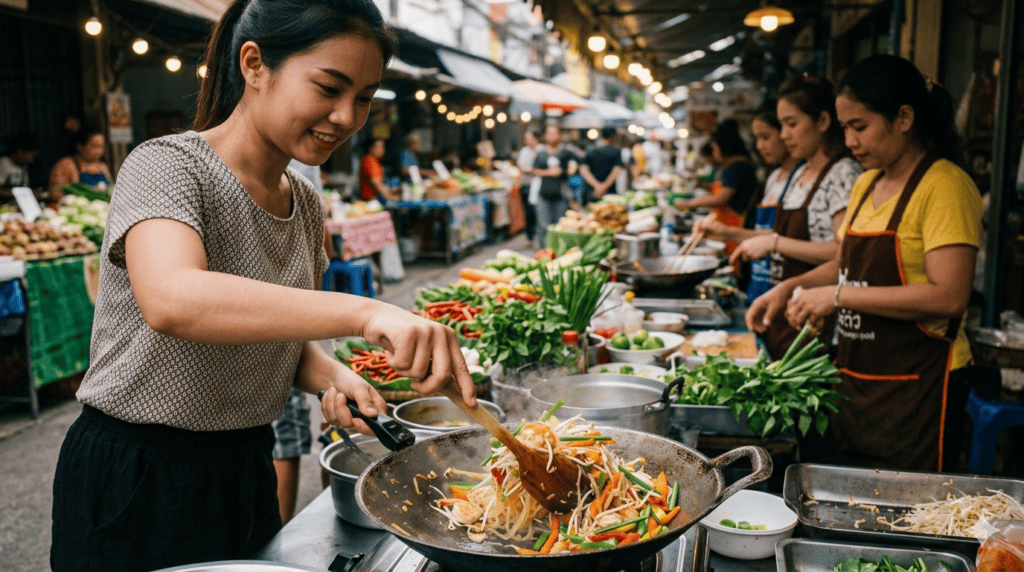
If you are planning a trip to Chiang Mai, a Thai cooking class will almost certainly end up on your list. And it should. There is no better way to understand a country than through its food, and Chiang Mai has become the cooking-class capital of Thailand. But here is the problem: there are dozens of schools, the listings all look the same, and the photos all promise the same smiling group around a wok. So how do you actually pick a good one?
I can help with that — because I once ran a Thai cooking school in Chiang Mai myself. For years I built and managed a cooking school here (and a travel agency alongside it), so I have seen this business from the inside. I know what separates a class you will still talk about years later from one you will forget by dinner. This guide is what I would tell a friend.
I first came to Chiang Mai in the mid-1990s and ended up running my cooking school here in the late 1990s. What drew me in was not a plan — it was a feeling. The quiet. The green that surrounds the city. The kindness of the people. And the food. The local northern cooking pulled me in deeper than anything else, and before long it became my way of understanding Thailand itself.
1. A Real Class Starts at the Market
The single biggest sign of a good cooking school is simple: it begins at a local market, not in the kitchen. A proper class takes you to a Thai wet market first, where the instructor walks you through the ingredients — the herbs, the curry pastes, the three kinds of basil, the difference between galangal and ginger. This is where the real learning happens. If a school skips the market and just hands you pre-measured bowls of ingredients, you are getting a cooking demonstration, not a cooking education.
I still remember walking visitors through the markets and watching their faces at the fruit stalls. The pineapple here tastes like a different fruit entirely — sweeter, brighter, sold in a bag with a little chili-salt if you want it. There is mangosteen, the small purple fruit with soft white segments inside that people fall in love with on the first taste. And then there is durian — the king of fruits — with a smell that empties a room and a flavor that, somehow, you end up craving. A good cooking class market tour is not just about curry paste and herbs. It is about all of this: the colors, the smells, the fruit you have never seen before.
2. Small Groups Beat Big Groups — Every Time
Ask one question before you book: how many people are in a class? The answer matters more than the price. In a group of six to eight, the instructor can actually watch your technique, correct your knife work, and adjust the heat under your pan. In a group of twenty, you are following along and hoping. Thai cooking is fast and unforgiving — a curry paste can go from fragrant to burnt in seconds — and you simply cannot learn that in a crowd. A slightly more expensive small-group class is almost always the better value.
3. You Should Cook, Not Watch
There is a real difference between a class where you cook and a class where you watch someone else cook. In a good class, you have your own wok, your own burner, and you make every dish yourself from start to finish. You should leave with sauce on your apron and a little pride. Be wary of classes that are mostly the instructor performing while you take notes. You came to Thailand to do, not to attend a lecture.
4. Authentic Recipes, Not Tourist Versions
A good school teaches you Thai food the way Thai families actually eat it — with the real balance of salty, sour, sweet, and spicy, and with the heat left in. A weaker school quietly tones everything down for foreign palates. The irony is that the toned-down version is the one you can already get at home. A real school will also let you cook something regional — a northern Thai dish you will not find on every tourist menu.
If there is one northern dish I would send every visitor to find, it is khao soi — a rich, golden curry noodle soup you simply cannot get right anywhere outside this region. It carries everything I love about northern Thai food: deep, comforting, a little crispy on top, with a balance gentler and rounder than the fierce flavors of the south. And here is something I learned over years of eating my way through the north: after something spicy, you need something sweet. That is the rhythm of a Thai meal. A glass of Thai iced tea — bright orange, cold, and creamy — is the perfect answer. The best cooking classes teach you both: the dish and the drink that belongs beside it. Learn to make khao soi and a proper Thai iced tea, and you have learned the soul of Chiang Mai on a tray.
5. A Few Practical Things Worth Checking
Before you book, a short checklist: Does the class include a recipe booklet to take home? Can they handle vegetarian, vegan, or allergy needs? Is hotel pickup included, or will you need to find the place yourself? How long is the class — a good one usually runs three to four hours or more. And finally, read recent reviews, not just the star rating. Look for reviews that mention the instructor by name and describe what they actually cooked. Those are the honest ones.
Morning or Evening?
Both work, and it comes down to your style. Morning classes usually include the liveliest market visit, when everything is fresh and the market is busy — and they leave your afternoon free. Evening classes are cooler, more relaxed, and end with dinner as the city lights come on. If the heat is not your friend, evening is the kinder choice.
Where to Book a Cooking Class in Chiang Mai
Once you know what to look for, booking is easy. I recommend using a trusted platform where you can compare classes, read verified reviews, and see exactly what each class includes before you pay — most also offer free cancellation if your plans change. You can browse, compare, and book through GetYourGuide, one of the booking tools I recommend on my Plan Your Trip page.
Final Thought
In all my years running the school, this is what stayed with me: people did not just leave with recipes. They left with an unforgettable experience — a morning in the market, the smell of curry paste being pounded, the first bite of a dish they made with their own hands. That is what a Thai cooking class really gives you. Not just food, but a memory you carry home.